After a very long 8 weeks of work, my extremely restless students and I could not wait for the 5pm bell to ring on Friday, signlaing the beginning of our two-week spring break. Eager for a change of scenery, I packed my bags and headed up to Paris on Saturday where I spent a day catching up with Kasey and Eric before my parents finally arrived the next morning.
Eric, Kasey and I
After making my way through the bowels of the Châtelet metro station in Paris (the largest underground transfer point in all of continental Europe), I picked up my parents who had just taken the train from the airport into the city. We hadn't seen each other in six months - it was so nice to see them in person versus just talking over Skype! Laden with luggage, we headed to our hotel and then set off to stroll the city for the afternoon. After a leisurely promenade and a relaxing dinner with my parents, Kasey and Eric, we turned in for the night - the next morning we were off to Morocco!
My mom & I enjoying the flowers in the Tuileries - quite a change from the snow that they left back in Westfield!
My dad and I - first family Happy Hour in quite some time!
If you're scratching your head because you have no idea where to find Morocco on a map or don't know much about the country in general, here are some fast facts:
The Kingdom of Morocco (currently presided over by King Mohammed VI) is situated on the northwestern tip of Africa. Directly south of Spain and Portugal, Morocco is located on the southern side of the Strait of Gibraltar - a narrow, 9 mile section of ocean separating Europe and Africa, which also connects the Atlantic Ocean with the Mediterranean Sea. Comprised of over 33 million people, Morocco is a diverse nation mainly populated by Berber Arabs who speak Arabic, French and English, along with a wide variety of Berber dialects. Primarily a Muslim country, mosques from many minarets dot the skyline, and gorgeous Arabic calligraphy, vibrant mosaics and Moorish architecture provide a beautiful feast for the senses.
The Strait of Gibraltar, separating Spain/Europe (bottom) from Morocco/Africa (top) as seen from our plane
The high Atlas Mountains separate the lower coastal part of the country from the sandy Sahara desert found in central and southern Morocco. While there may have been snow-capped mountains in the distance, weather in Marrakech was anything but chilly! Full sun everyday and temperatures topping out in the high 70's to low 80's made for a much-welcomed respite from rainy Forbach for me, and from snowy Westfield for my parents! Morocco is, however, a modest country when it comes to dress codes, and thus we chose to stick to jeans and t-shirts over shorts and tank tops (despite the heat!) to better fit in. In any case, we ended up getting plenty of sun to breathe a little life back into our pasty white complexions!
Taking a break from the sun - and modelling a super-trendy straw hat!
An added perk of vacationing in Morocco: it's super cheap! We flew with the European budget airline Ryanair, which has ridiculously inexpensive flights to various destinations throughout Europe & northern Africa. For 3 people to fly from Paris to Marrakech, then from Marrakech to Madrid, and finally from Madrid back to Paris, we spent under $600 - for a total of 9 flights! And with the current exchange rate, $1 USD is worth 8 Moroccan dirham (which works out even better for me, as 1 Euro = 11.25 dirham!). Hello cheap food & souvenirs!!
Show me your dirham!
After a quick 3-hour flight from Paris, we touched down in Marrakech. Although it took us forever to get through the severely understaffed passport control check-point, we were soon whisked away in a shuttle to our hotel.
Ok, so maybe "whisked away" is a little too graceful of a description...
A very modern shuttle van was waiting to pick us up at the airport and we enjoyed a scenic tour of the old and new parts of the city on our way towards our hotel. The streets continued to get narrower and dustier, eventually becoming so congested with pedestrians, people on scooters, mules pulling carts, etc. that our driver informed us that he could take us no further. My parents and I all exchanged strange looks as our taxi driver quickly negotiated something in Arabic with a man pushing a rusty little metal cart alongside the van, and the next thing we knew our luggage was being packed into said cart and we were following our new "guide" to the place where we were staying - his cart could actually fit down the narrow alleys where the taxi could not.
Derb Allilich, the "street"/alley on which our riad was located
Completely outside our usual comfort zone - as absolutely nothing about our current situation resembled anything we'd ever experienced before - we apprehensively followed our bags to our hotel (which from the outside looked like a filthy mud-brick building) and held our breath as the second "taxi driver" knocked on the door...I think I can speak for all of us when I say a collective sigh of relief was released as we entered the stunning riad!
The inner courtyard at our riad
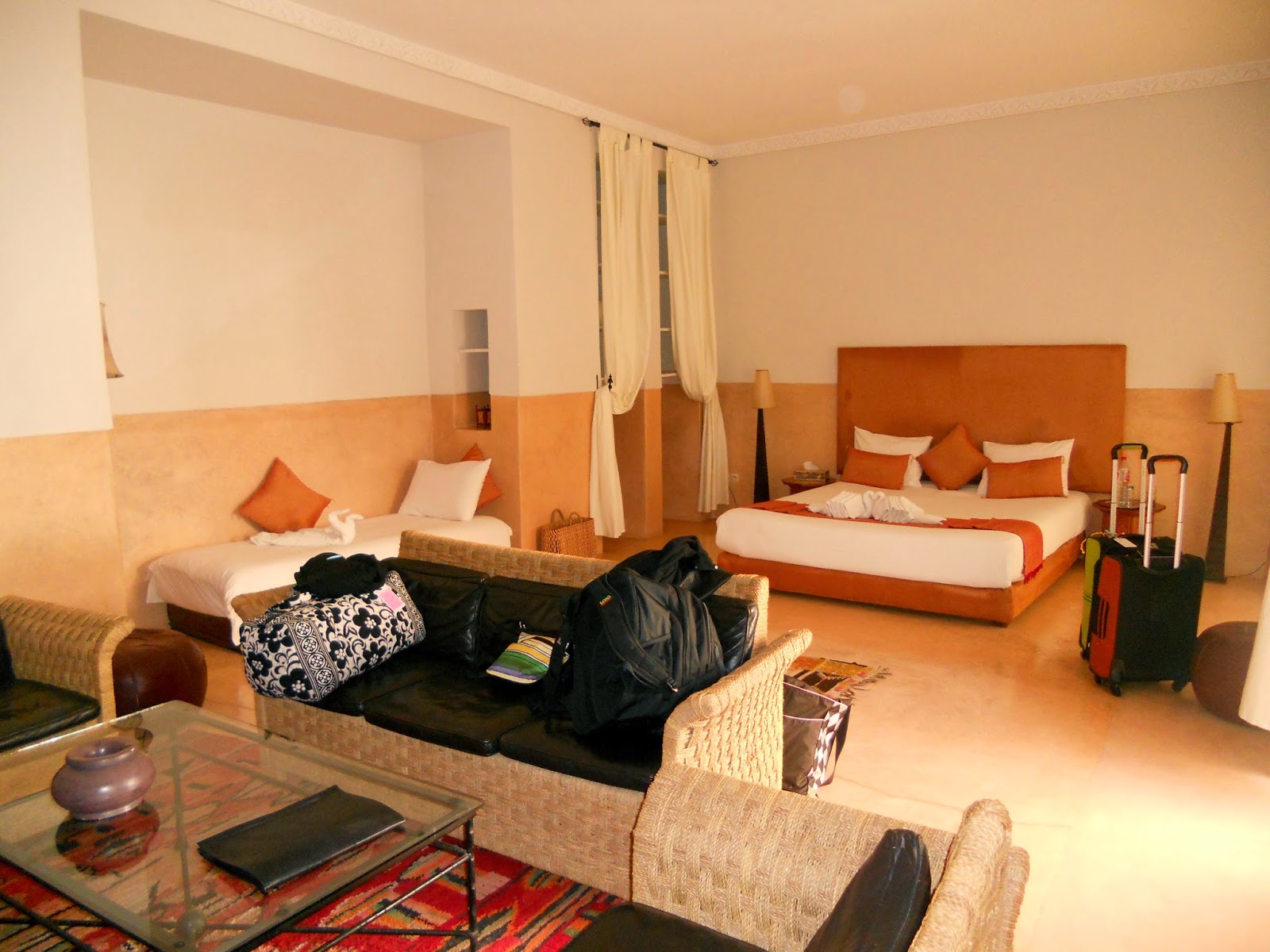
We opted to go for a more traditional Moroccan experience by staying in a riad (from the Arabic ryad meaning "garden") instead of a conventional hotel. Riads are traditional Moroccan houses with an interior courtyard/garden, and many former private homes have been beautifully restored and turned into small boutique hotels - ours only had 5 rooms inside. Our riad, Dar Lalla F'Dila, had a great bed-and-breakfast feel to it, complete with a spacious inner courtyard, breakfast terrace and rooftop solarium with a great view of the city and its surroundings.
Our massive room! Stone floors keep the room cool even during the hottest part of the day
The solarium, where you can relax in the sun and sip your mint tea
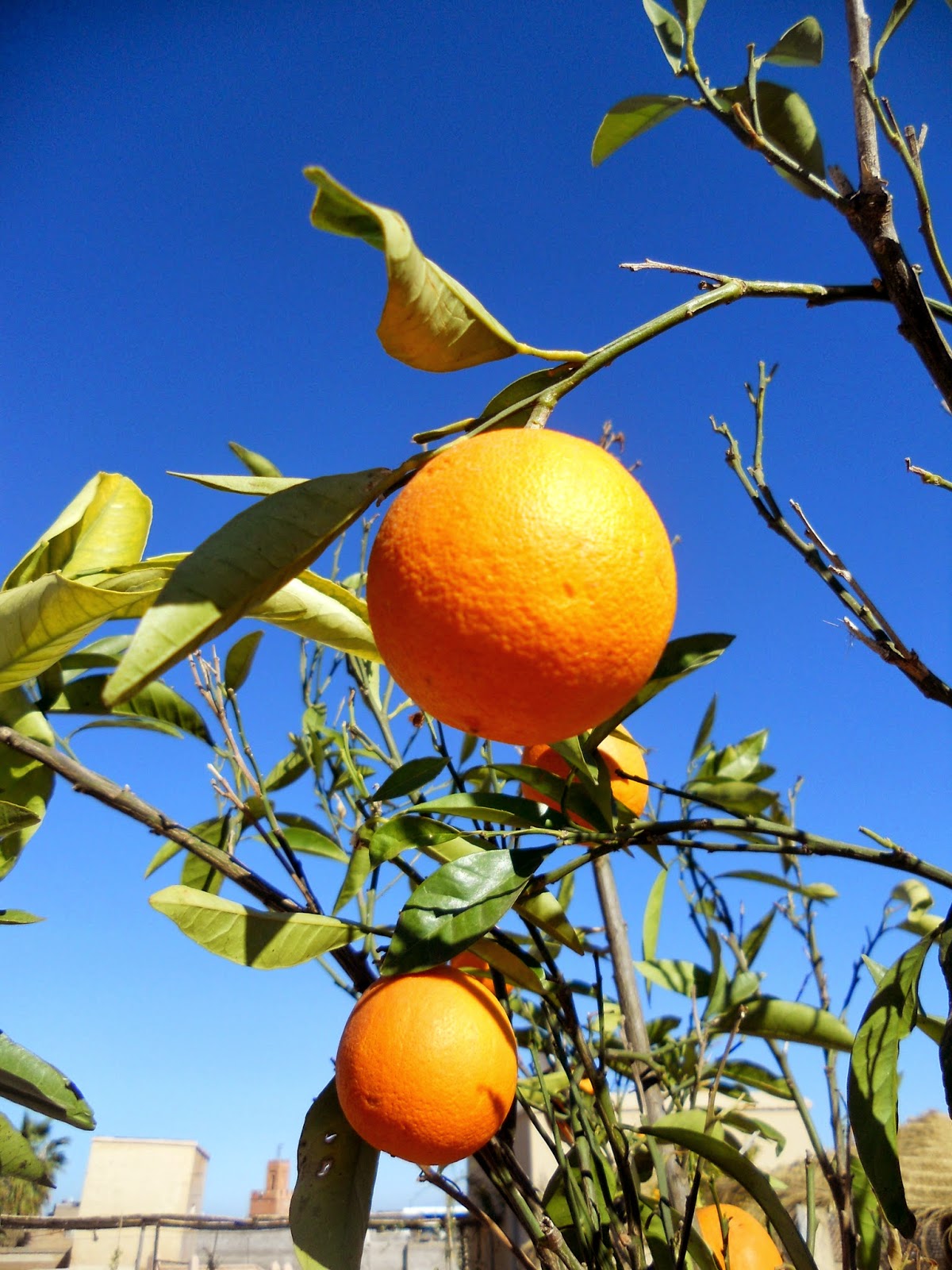
Juicy oranges growing on the rooftop's garden
We settled into our room and were given a quick run-down of the ins and outs of Marrakech over some delicious mint tea and homemade cookies. Theoretically, we were less than a 10-minute walk from the main square, Place Jamaa El Fna - but to get there, we'd have to meander our way through the maze of souks, the city's famous open-air markets. I'd done my research before leaving for our trip and thought I was fully prepared to take on the city - armed with a few trusty maps, and a decent sense of direction, I figured we wouldn't have any issues whatsoever: WRONG!
While this map may seem detailed enough, with most of the main attractions shown, notice how many streets are dead ends and just generally don't have a name! Happy wandering :)
"Just look for the distinctive mosque towers," my guide books had said.
That may had been great advice if you were standing in a big square looking for a point of reference, but when you're wandering aimlessly through mostly unmarked 6-foot wide alleyways surrounded by 20 foot walls all while trying not to be killed by people whizzing by you on mopeds, this proves not to be such an easy task!
"Don't agree to be led by locals through the streets to your destination," they said. "They'll just end up wanting your money for being so helpful."
Again, this sounds good in theory, until you have the classic deer-in-the-headlights look upon your face in a totally non-touristy area and are clutching a map, desperately trying to figure out which one of the 6 alleyways at the intersection you should take to lead you to your destination.
One of the plethora of hand-cut tile mosaics that decorate the city
Cue the boys saying "Hey mister, hey lady, are you lost? We can help you!" Even after politely refusing to be helped and saying we didn't want to pay for a guide, a group of boys told us that they were going the same way as us anyways and would be totally happy to show us the way, no money needed. Skeptical but secretly yearning for some friendly locals' advice, we stupidly agreed to be lead "the back way" to the city's main square...which ended up instead at the tanneries where the boys' father had a leather shop. Of course, they wanted money because they had "helped us" to go in the "right" direction...after my parents politely declined in English, I tried to diffuse the quickly escalating situation in French, only to be called a slew of obscenities. Lesson learned: always look like you know where you're going, even if you are totally lost!
Vendors selling handmade hats in one of Marrakech's many souks
We stumbled into another family of lost-looking British tourists, and after laughing together for a few minutes about how crazy the city seemed (they had just arrived that morning as well), we decided to set off together to try to find the elusive Place Jamaa El Fna. As they say, there's strength in numbers - we finally made it! And what a sight it was to take in...we decided to grab some drinks together at a cafe with a rooftop terrace so we could check out all the action swarming in the square below.
Place Jamaa El Fna, while the day markets are set up
Snake charmers and monkeys and musicians, oh my! The market had everything from fresh-squeezed orange juice vendors to burqa-clad women doing henna designs, snake charmers and their slithery companions to diaper-wearing monkeys posing for pictures with tourists. Vendors peddling pottery, leather goods, spices, Berber pharmaceutical remedies, candied fruit, freshly-slaughtered meat...you name it, you can find it here! Clusters of stray cats sit beneath counters at butcher shops, waiting for a piece of the entrails that hang from metal hooks above the store window to fall to the ground. Old men sit whittling camels out of olive wood. Oriental rug dealers flip through carpet after carpet, trying to entice clients inside their shops with aromatic pots of freshly-brewed mint tea. It was truly a beautiful sight, so much to look at and something the likes of which I had never before seen.
A shop in the spice market, also selling crocodile and giant snake skins
Another thing you'll notice about Marrakech is that its Islamic heritage takes a central place in daily life. A few examples: there are mosques and minaret towers everywhere you look, alcoholic beverages are hard to come by, people dress very modestly, and Islamic art and architecture pervade the landscape. Also, you'll probably stop in your tracks the first time you hear the adhan, or call to prayer, shouted by various muezzins from the mosque towers. (While I don't pretend to be an expert on Islam, I have taken a few comparative religion classes during my college years and as such have a basic understanding of the religion.)
First, the call to prayer itself is issued (this happens 5 times a day at set times). Next comes a call for the faithful to line up facing Mecca in order to begin praying. All mosques make these announcements, including a basic summary of the beliefs of Islam, in order to make all people (including non-Muslims) aware of the basic tenets of the faith. The adhan announces one of the Five Pillars of Islam, that there is no deity but Allah, and Mohammed is his prophet. In my video below, you can hear the call to prayer being announced from multiple mosques at the same time (you can pick them out because they have towers next to them), and when the camera pans all the way to the right, you can see people stopping at the entrance to a mosque and taking off their shoes before entering to pray.
After a delicious Moroccan dinner - I had a beef tajine, where meat is slow-cooked in a conical shaped earthenware pot with apricots, nuts and a sweet syrupy sauce over coals - my parents and I turned in early after an overwhelming afternoon wandering the city. I don't often feel out-of-sorts due to culture shock, but I have to admit that even I was a bit thrown for a loop upon our arrival in the city. Thankfully most signs are in both Arabic and French (France had colonial power in Algeria, Tunisia and Morocco beginning in the 1830's, with control over Algeria lasting even up until the 1960's - hence a strong French influence in this region of Africa called the Maghreb), so my ability to read signs, menus, etc. and communicate with the locals who only speak English to a limited degree definitely helped me to feel more comfortable. Feeling more confident the next morning, we set out to explore the city some more.
The Koutoubia mosque's minaret, seen from Place Jamaa El Fna
Venturing far across the city, we went to Les Tombeaux Saadiens, a site containing late 16th century tombs from the Saadian dynasty. Undiscovered until 1917, the brightly tile-covered tombs, along with their intricately carved architectural surroundings draw large crowds on a daily basis. For 10 dirham (about $1.25) you can stroll through the tombs and their gardens, peppered with orange trees and flowering shrubs. And cats! Marrakech is absolutely filled with stray cats - at any given time you can see 5 to 10 roaming around - and they really like to sun themselves inside the tombs.
The minaret for the mosque adjacent to the Saadian Tombs
Cute little kitty getting some sun in the tombs' gardens
Some of the less-decorated tombs. Those interred are buried on their left side facing the holy city of Mecca.
Architecture inside the tomb grounds
Crazily detailed, breath-taking stonework decorates the vaults
Room of the Twelve Columns, where Sultan Ahmad al-Mansur's son is entombed, richly decorated in carved stucco, mosaics, and painted cedar woodwork
Our next adventure: a one-hour camel ride through a palm tree oasis! This was on my To-Do List for Morocco, and our riad was able to set it up for us. We took a taxi outside the city to the Palmeraie, a 32,000 acre palm tree oasis. Home to over 150,000 palm trees, glamorous golf courses and ritzy resorts, the Palmeraie is a nice escape from the bustling market atmosphere.
The Palmeraie
The three of us formed a sort of camel conga line along with two other tourists from Lebanon and Mexico, and a Berber camel herder led us on a tour of the oasis for the next hour. No one quite prepares you, however, for the bizarre experience of riding a camel. For instance, we weren't aware that after awkwardly climbing up onto the camel saddle, your beast quickly stands up with its back legs first, launching you forward headfirst towards the ground - thankfully there's a handle on the saddle, or I would have been toast!
Me ever so gracefully climbing onto my camel
In shock after almost being launched off my camel as it got to its feet
We got quite a laugh from that and then consequently chuckled the rest of the way, camels are strange animals full of bizarre sounds and lurching movements. Definitely something I'm happy to say I did - where else can you ride a camel at home besides in a parking lot next to the circus tent?!
Dad's new camel friend, who liked rubbing his nose on his jeans the whole time
Mom leading the pack
Just us and our dromedaries
We talked with the other two people on our camel ride and decided we'd all head back into town and go visit Medersa Ben Youssef and the adjoining Musée de Marrakech together after our camel adventure was over.
A former Islamic college attached to the Ben Youssef mosque whose students learned the Koran by rote, Medersa Ben Youssef was founded during the 14th century. You can visit the inner courtyard, richly decorated with bright mosaics and carved cedar woodwork, as well as some of the 130 student dormitory cells surrounding it. Medersa Ben Youssef was the largest theological college in Morocco, with a student body of up to 900 people, and finally closed in 1960.
Whitewashed walls, bright mosaics and alluring carved stucco provides a peaceful, contemplative environment
In Medersa Ben Youssef's central courtyard
I can only imagine how many man-hours were required to sumptuously decorate nearly every visible surface of this building
Peering out of a dorm room
Next door, the Musée de Marrakech is situated in the 19th century Dar Menehbi Palace and displays a vast collection of artifacts pertaining to the history of the city. Old coins, Berber pottery, games, books and musical instruments give you a taste of what life in Marrakech was like in former times.
An old tiled fountain in the museum's central courtyard
While checking out the exhibits you get to
explore the palace and even see inside its hammam, a sauna-like bathing room.
Marrakech is known for its hammams - they are often found just next to
mosques. Hammams are traditionally connected to ritualistic purification,
called ablution, where Muslims cleanse themselves before prayer. From
what I understand, you pay a nominal fee (sometimes just 10 dirham, about
$1.25) go into the hammam - essentially a giant steam room - steam for a
while and then have someone scrub you down with an exfoliating mitt.
Fancier/more modern hammams even include massages and herbal body wraps.
We were a little too apprehensive to wander into one of the dark, steamy
looking hallways you find off the main roads leading to the hammams and have a
stranger scrub us down, but maybe next time I'll be a little more adventurous!
Inside the Musée de Marrakech
In Marrakech, it seems that all roads eventually lead back to Place Jamaa El Fna, so we once again found ourselves wandering through the souks back to the main square. We did our fair share of shopping along the way, though. Here, you must master the art of haggling if you don't want to pay exorbitant prices for things you buy. The rule: if the price isn't marked, it's between you and the craftsman to determine.
Ceramics on sale in one of the souks - note the conical tajine pots at the bottom right
For example, leather is made in Marrakech, and
consequently many shops are selling hand-crafted leather sandals, wallets,
purses, belts, etc. I found a really cute leather wristlet - purple with
embossed floral designs - at one leather workshop and asked the artisan how
much he wanted for it. He named his price: 400 dirham (about $48), which
in the US wouldn't be an exorbitant amount to pay for a nice leather purse.
In my research, however, I learned that buyers should start by offering
1/3 of the original offer and working up to a "realistic" price.
Thankfully, my mom and I make a good haggling team (feigning disinterest and
making for the exit when you're not getting anywhere helps too!) and a few
minutes later I walked out of the shop with my new purple purse which I had
snagged for only 150 dirham (only $18!). I was able to buy a bunch of
things for a fraction of the original price: a set of 6 bright Moroccan tea
cups ($16), colorful leather sandals ($9), even a hand-carved cedar wood donkey
($7) to put on my knick-knack shelf at home. If you had big enough
suitcases to haul everything back, you could buy up so many beautiful, locally
sourced, hand wrought items to furnish your home for insanely cheap prices that
it really blows your mind.
A Berber Apothecary, selling traditional indigenous remedies for all sorts of ailments
Here's a quick glimpse into the craziness of Place Jamaa El Fna. We enjoyed sitting in the sun with some refreshments and people-watching from various rooftop terraces around the square in the afternoons. It's like a giant game of I Spy: snake charmers (playing their stereotypical pungi music), Berber drummers, monkeys, stray cats...the list goes on!
That night we splurged and made dinner reservations at a
fancy restaurant called Le Foundouk, specializing in traditional Moroccan
cuisine. I'm always eager to try regional specialties when I travel, and
I had read up on dishes typical of Marrakech before arriving, so when my eyes
spottedpastilla on the menu I couldn't resist.
My delicious pastilla
What ispastilla, you ask? Pigeon pie, of course! Tender pigeon meat is baked
in a flaky pastry crust, drizzled with honey and topped with crunchy nuts -
absolutely delicious! (And in case you were wondering, pigeon tastes like dark
meat from a chicken.) While some might turn their nose up at this, I'd
definitely say it's a must-try. Wash that down with some Moroccan wine,
finish up with pistachio crème brûlée topped with a dollop of dark chocolate mousse and you've had
yourself a delectable, relatively inexpensive dinner. The three of us had
a veritable feast, complete with multiple rounds of drinks and desserts for less than $120 -
for the quality and quantity of food in such a nice restaurant back in the US,
there's no way you'd get away that cheap!
Enjoying the sun during our calèche ride through the city
We started our last full day in Marrakech by hiring a calèche, or horse-drawn carriage, to take us for a tour of the city. Our driver brought us through both the old and new cities, and we were able to cover a lot more ground in an hour than we could ever roam on foot! It was a nice relaxing way to see the city - and soak up some sunshine!
The kasbah walls, marking the fortress around the medina (old city)
The Koutoubia minaret
Roaming through the souks again, I couldn't resist getting a henna tattoo on my hand. A paste made of powdered leaves from the henna plant and various essential oils, henna is applied to the skin using a cone or syringe, and as the paste dries it stains the skin a bright orange to dark brown color. The designs can last anywhere from a few days to a few weeks - I was disappointed that mine was gone within a week, but due to sunny weather the design is now fixed in negative form on the back of my hand due to my tan - cool anyways I guess!
My henna!
We also headed across town to visit two former palaces: Palais El Badi and Palais de la Bahia. Palais El Badi (meaning "The Incomparable Palace" in Arabic) sits mostly in ruins today but was commissioned by the sultan in 1578. Originally composed of 360 rooms, an underground prison and a massive swimming pool, El Badi was richly decorated with Carrara marble brought all the way from Italy, as well as tons of mosaics. It took 25 years to build, but was then completely looted over a period of 12 years in the 17th century after the rise of a different dynasty of sultans. Today, most of the central courtyard has been turned into an orange grove, and a phalanx of storks now calls the top of its walls home.
Storks nest along the top of Palais El Badi's walls
Inside the walls of former guest apartments at Palais El Badi
El Badi's central courtyard, with a view of the snowy Atlas mountains in the background
Enjoying the mosaics and a break in the shade
Next stop on our palace tour: Palais de la Bahia ("The Beautiful Palace"). Begun in the 1830's and completed by 1900, this palace was built by two different viziers (advisers) to the sultan and has a rather erratic plan. Gardens, courtyards, and special areas to house the visiers' harems make for a maze-like visit through the palace. Once again, colorful mosaics, intricate carvings and bountiful gardens embellish the palace grounds...I'll let the pictures do the talking:
Dinner that night was quite the adventure - we braved the night markets of the central square to find a delicious fresh-cooked feast! Place Jamaa El Fna transforms mid-afternoon as the snake charmers leave, the infamous transvestite belly dancers appear, and the night markets set up shop. Row after row of tents complete with kitchens, dining areas and very friendly workers appear to try to entice you into eating at their stand. Literally every "restaurant" is selling the same thing for the same prices, it's just a matter of which one you decide to stop at. Fresh couscous, roasted vegetables, shish kebabs made from saffron chicken, prawns, lamb, kefta (beef) and fish, potato cakes, herb-marinated olives and of course fresh Moroccan flatbread called khobs await the hungry visitor. As many tourists (including us) are wary about eating in markets here (they get a bad rap for gastrointestinal distress - not due to lack of cleanliness, per se, but for the fact that visitors aren't accustomed to drinking the local water used in food prep and dish-washing), many vendors shout things like "Eat at number 85, stay alive!" or "2 year no diarrhea guarantee!" . We had a delectable feast and I would definitely advise stopping for dinner at the night market to anyone passing through!
Our chef at the night market, clearly proud of his fire-roasted peppers
I would recommend Marrakech hands-down as a travel destination. While at times you feel completely outside your comfort zone, I found it refreshing to get a taste of a culture so dissimilar to my own. Francophones will have an easier time getting by here, but the locals are very welcoming to all and a little kindness and patience on behalf of the tourist goes a long way to making your trip here an enjoyable and memorable one! Most importantly: keep an open mind! You never know what neat things you'll discover when you open yourself up to a new way of life.
Drinking our tea the fancy way - pinky out!
One last tea-time back at our riad, and it was time to pack up our bags - for the next morning, we were off to Madrid!
As I'm a huge fan of cooking (and eating!), I've decided that there's no better time to channel my inner Julia Child and whip up some French cuisine than while living in France. With a gamut of "exotic" French ingredients readily available at the local supermarket, strolling the aisles and picking something new to try is always an adventure. Recently, I've cooked up confit de canard (duck thighs preserved in duck fat and then roasted in the oven - my favorite!), crêpes, coq au vin (chicken simmered with mushrooms, carrots and onions in a delectable red wine sauce), boudin (blood sausage) with balsamic-glazed apples...the list goes on! And a few nights ago, Meike and I decided to cook something which is more of a regional specialty: flammekueche.
The Alsace-Lorraine region of France
Though this dish is technically from our neighboring French region of Alsace (we live in Lorraine), our two regions are often lumped together in terms of cuisine and tourism and collectively known as Alsace-Lorraine (close enough!).
What is a flammekueche, you ask? Also known as a tarte flambée, or more simply a flamm, it's essentially a thin-crust pizza traditionally baked in a wood-burning oven. Comprised of very thin dough covered with crème fraîche (similar to sour cream), Bibeleskäse (fresh cheese with a yogurt-like consistency), or some combination of the two, the flamm is topped with a dash of salt, pepper & nutmeg and then sprinkled with thin-sliced onions and chunks of French smoked bacon - what's not to love? Throw a little grated Gruyère cheese on top and you've got yourself a flamm gratinée. Swap out the cheese for mushrooms, et voilà, a flamm forestière is born. The possibilities are endless!
At a restaurant, you usually eat your flamm right off a wooden pizza peel!
With humble rural origins, the flammekueche is traditionally served as an appetizer and paired with a chilled glass of crisp Alsatian wine like Riesling, Gewürztraminer or Pinot Gris. Since the 1960's, their popularity has grown and now many restaurants serve flamms as a main course as well, just as you'd order a personal pizza in the US. Originally a meal for the working-class, farmers would use them to celebrate their bread-baking day (which occurred only once every 2 to 3 weeks) by saving a bit of their bread dough and turning it into this sumptuous, bubbly treat. Flamms would be popped into the oven while it was heating up to cook the bread, and the workers would all gather around the oven to warm up and hopefully grab the first one to come off the fire.
We've enjoyed numerous flamms at local restaurants, so Meike and I decided we'd take a shot at making our own!
Before baking...
Here's the recipe we used (although the variations on the crust recipe are infinite!)...
Flammekueche for 4 people
Oven: as hot as it will go
Ingredients for the crust:
- 250 grams flour (2 cups)
- 50 mL vegetable oil (1/4 cup)
- 1 pinch of salt
- 1 glass of lukewarm water (very specific, I know...I just added enough until I had a pizza dough consistency)
- no leavening agents
Mix the flour with the salt and then add the water and knead well until you obtain something that feels like pizza dough. Form it into a rectangle on a cookie sheet and try to make it as thin as possible without tearing.
Topping:
- 20 cl of thick crème fraîche (a little less than a cup)
- 100g fromage blanc (about 1/2 cup of farm fresh cheese - plain yogurt might be the closest substitute?)
- 3 onions
- smoked bacon cut into matchsticks
- salt & pepper to taste
- dash of grated nutmeg
- 1 tablespoon vegetable oil
1. Preheat the oven as hot as it will go without using the broiler. (You want the heat to come from the bottom of the oven just like for pizzas).
2. Mix the crème fraîche and the fromage blanc in a bowl. Add the oil, and then season with salt, pepper and nutmeg to taste. (If you're using particularly salty bacon, go easy on the salt!)
3. Thinly slice the onions (preferably on a mandolin) so they'll be able to cook quickly in the oven.
4. Spread the cream/cheese mixture on the crust, but be sure to leave a border around the edge of about 1 cm. Top with bacon and onions, but don't overdo it - remember: this is supposed to be a light pizza. Add additional toppings (like grated cheese or mushrooms) if desired.
5. Pop the flamm into the oven, but keep an eye on it. Cook for between 8 and 12 minutes - the crust should start to become golden and the onions should look cooked. Slice it up and serve hot!
**We ended up needing to double the dough recipe - as we don't own a real rolling pin, stretching the dough extra thin was quite difficult. The amount of toppings was perfect though!
After baking!
Although a bit labor-intensive, the end result was pretty tasty! If you're ever passing through Alsace-Lorraine, make sure you try one of these French "pizzas" - you won't be disappointed!
And as for my recent adventures outside the French culinary sphere...
At the Phoenix concert in Paris (check out the awesome Hall of Mirrors background from Versailles!)
I spent a weekend in Paris with Kasey at the beginning of the month - we had tickets to see the French rock/electronic band Phoenix live in concert at the Palais des Sports. (They're from Versailles, just outside of Paris, but sing in English - the lead singer's actually married to American director Sofia Coppola. While not hugely popular in the US, they do get some airtime on the radio - check out a video from the concert below!) The sold-out concert was absolutely spectacular and we had a fun weekend full of late-night/early-morning debauchery as well...
And then Meike and I spent the next weekend back at her house in Germany with her family. Her oma (grandma) turned 80 and there was a party for her at a restaurant on Sunday to which I was invited , but we got some relaxing and sight-seeing in as well. We went for a dip at the local pool, checked out the architecture at the cloistered Schöntal Abbey (founded by the Cistercians in the 12th century), and did important things like catch up on DSDS (the German version of American Idol - has the same intro music and all, but no Ryan Seacrest...) and Der Bachelor (you guessed it, The Bachelor - equally superficial and ditzy here too!). It was great to spend a weekend away from Forbach with some familiar faces in a family setting, and I'm hoping to squeeze in one last visit before I return to the US!
The church at Schöntal Abbey
Impressive baroque decor inside the church
Meike and her brother Stefan at Schöntal Abbey
I'm just wrapping up 8 weeks of continuous teaching (a whopping total of 96 hours of work!) since the last break and am looking forward to having the next two weeks off - my parents get to Paris on Sunday morning and then it's time to do some travelling together! Stay tuned for news from my coming adventures!
January 26 marked the 24th anniversary of my entry into this world - and what better place to spend it in than Paris?! Ever eager to head back to the big city, I took a train on the evening of Friday, January 24 and headed up to Paris where my parents had booked a hotel room for Meike, Kasey and I for the weekend. (Sadly, Meike's grandfather had passed away earlier during the week, so she had to head home for services during the weekend instead of celebrating with us - but she was there in spirit!)
As I didn't arrive in the city til late Friday night, Kasey and I decided to lay low and save our energy for Saturday night instead. On Saturday, we each did our own thing for most of the day - I had some errands I wanted to run and Kasey had a meeting and some paperwork to get done. Paris is a very flat city (with the exception of Montmartre) so it's ideal for strolling around and people watching, conveniently two of my favorite activities!
Just passing by the French Senate building in the Jardin du Luxembourg - can't wait until it's springtime and this park is in full bloom again!
After grabbing a ham, egg and cheese crêpe from my favorite little hole-in-the-wall in the St-Michel neighborhood, I munched and shopped on the rive gauche for a while. January is famous for les soldes (the huge annual sale events in most stores) and consequently wherever you decide to shop, from little boutiques to huge department stores, is jam-packed with people who are sifting through every last item, hoping to snag that one item whose price is too-good-to-be-true. [But putting up with the crowds can be worth it - I happened to snag a pair of boots that started at 80€ for under 35€ in Metz a few weeks prior!] Prices are slashed up to 80% in some places, so you can really score some good deals if you have the patience to pick through the store displays that have been literally turned upside down by all the other bargain-hunters. I actually felt bad for the poor employees who had the arduous task of re-folding all of the clothes that had been rifled through, what a thankless and never-ending job!
I had also read online that there was a Breaking Bad expo taking place at the Fnac (similar to Best Buy) inside Forum des Halles, a large underground mall in the heart of Paris. Being such a fan of the show, there was no way I was going to miss it - even if it meant battling the crowds inside the mall to get to it!
Tada!
While the expo was a bit smaller than I was expecting, there was still a neat collection of costumes and props from the show on display. I had to chuckle at some of the awkwardly translated signs that explained the contents of the case in French, but nonetheless I was impressed.
A fry batter bucket and other props from Los Pollos Hermanos
One of Jesse Pinkman's typical thug outfits - although I was disappointed Aaron Paul wasn't there to live-model them!
A "White Family Photo" and Skyler's mug from Ted Beneke's office
Jesse's license plate!
After my shopping spree was over (not that I bought anything worth mentioning) & I had gotten my Breaking Bad fix, I headed over to the 20th arrondissement to visit my former host parents, Béatrix & Quentin. We had a great time swapping stories for a couple hours and popping a bottle of birthday champagne - they really are the sweetest, most welcoming people you could know and I always feel like I'm going back "home" whenever I swing by to say bonjour! It's so comforting to have familiar faces who are so happy to see you when you find yourself in a land thousands of miles from your real home.
Notre-Dame, still sporting her Christmas tree
Swinging back to our hotel in the 10th arrondissement, it was time to don my party dress and get ready for an evening of celebrating! After getting all pretty, Kasey and I jetted over to the infamous Rue de Lappe in the Bastille neighborhood for a delicious dinner of traditional French fare. My confit de canard (duck which has been preserved in its own fat and then tenderly roasted until the meat gracefully falls off the bone) was cooked to perfection, and some home-made mousse au chocolat, along with a bottle of my favorite Côtes du Rhône wine rounded out my meal. In typical French fashion, we took our time eating and didn't leave the restaurant til nearly 11pm!
Keeping it classy in black and hot pink - ready to hit the town!
Next stop, house party! We had been invited to a party at one of Kasey's friend's houses just on the edge of the city, and after a ride on the metro involving some sketchy characters, we arrived just in time to see the clock tick midnight - the official start to my birthday! The evening was fun and relatively low-key, but if my headache the next morning was any indication, I thoroughly enjoyed myself!
Sacré-Coeur
Before taking the train back to Forbach, I took a birthday stroll in one of my favorite Parisian neighborhoods. Ambling along with the crowds of tourists (I was told school break in Italy was taking place while I was there, so there were tons of Italians vacationing in Paris at this moment!), I didn't fail to once again become captivated by the beauty of Sacré-Coeur basilica, crowning the butte of Montmartre. And even though it was a foggy day, the view of the city from the top of all those stairs you climb to gain access to the church was (and always is) worth the effort.
Upon arriving back in Forbach, I was greeted by Meike and a spread of birthday gifts from her and her family - even a chocolate-covered birthday cake! We had some cake, I opened my presents, and it was a nice quiet evening to finish off my birthday extravaganza weekend.
My birthday cake and German-imported presents :)
What's on tap next? This coming weekend, I'll once again be headed back to Paris to stay with Kasey and then see a concert by the French band Phoenix on Saturday night. The following weekend, Meike and I will head back to her house in Öhringen. And a month from today, my parents will be touching down in Paris to spend a 10-day whirlwind adventure with me, with stops in Marrakech and Madrid along the way! I had such a great time showing them around France when they came to visit me two years ago, and I can't wait to explore some new places with them this time!